
How to Find Bridgeport Residents
Bridgeport does not have one master list of every person at every address. The useful record depends on what “find” means. The assessor can show a record owner and a mailing address. A voter lookup can answer a named registration question. A deed index can prove that a person or entity appeared in a recorded instrument. The Bridgeport History Center can place a household at an address in an older year. Courts, vital records, licenses, and business filings add time-stamped clues, but each has its own access rule.
Begin with the narrowest question. If the starting clue is an address, keep the parcel number and legal description beside the search notes. If the clue is a name, write down initials, spelling variants, a possible married name, and an approximate time. The official trail can miss renters, unregistered people, protected voters, and household members who never appear in an owner record. That is a limit of the record, not proof that a person is absent.
- Search the Bridgeport Vision property portal by address, owner, account number, MBLU, or PID.
- Use the Connecticut individual voter lookup only when the question concerns a named registration and polling record.
- Convert the parcel into an owner or legal description, then search the Bridgeport Town Clerk land index.
- For family history, read the Bridgeport History Center's city directory, newspaper, yearbook, map, and genealogy holdings.
- When an online result ends, contact the custodian, library, courthouse, or records-request route that holds the next layer.
Bridgeport Resident Records Offices
Fairfield County is a geographic label in Connecticut, not a current county records government. County government ended on October 1, 1960, so Bridgeport searches should not be sent to a fictional Fairfield County recorder or county jail. The Bridgeport Town Clerk holds municipal land records and maps. State systems handle courts, vital records, elections, professional credentials, and custody information.
Bridgeport Town Clerk
City Hall, 45 Lyon Terrace, Room 122
Bridgeport, CT 06604
203-576-7208
Bridgeport Tax Assessor
City Hall, 45 Lyon Terrace, Room 105
Bridgeport, CT 06604
203-576-7241
Bridgeport Registrar of Voters
999 Broad Street
Bridgeport, CT 06604
203-576-7281
Those offices answer different parts of a residents directory question. The Bridgeport residents directory workflow works best when the Town Clerk supplies an official instrument or map copy, the assessor explains a card or Grand List field, and the registrar explains registration through the state system. Write down the office, record date, and document number instead of treating every result as the same kind of resident record.
Bridgeport's Three Resident Sources
For a current Bridgeport parcel, the most useful chain is Vision, GIS, and the Town Clerk. Vision turns a street address into an owner, mailing address, account, MBLU, PID, assessment, and sometimes a field-card link. GIS shows the polygon, street placement, parcel IDs, address ranges, and nearby lots. The recorder then gives the legal instrument trail. These systems overlap, but they do not promise the same fact.
| Source | Best clue | What it does not prove |
|---|---|---|
| Vision assessor | Record owner, mailing address, situs, assessment fields | Every occupant or a certified title conclusion |
| MetroCOG GIS | Parcel shape, ID, street range, adjacent geometry | Who is physically present at the parcel |
| Town Clerk I2 | Grantor, grantee, instrument, date, legal description | A current household roster |
Use the assessor owner as a bridge to the recorded-land name search, and use the GIS ID or MBLU to keep the parcel straight when a surname appears on more than one lot. A mailing address may belong to a trust, estate, business, representative, or person outside the situs. A deed proves a recorded transaction, not a day-to-day living arrangement.
Search Bridgeport Resident Records by Parcel
The Vision search is the fastest way to make a street clue usable. Its source selector offers Address, Owner, Acct#, Mblu, and PID. MBLU is split into Map, Map Cut, Block, Block Cut, Lot, Unit, and Unit Cut fields. A searcher can start with the street number, then refine with a PID or parcel identifier when the property has a common street name or several units.
The Vision search page is public and does not require a login. Its visible field model does not state a minimum character count or a universal partial-match rule, so try a full street form and a name form separately. The 2025 Grand List and final October 1, 2025 revaluation are current assessment context. Put that year beside any value or card field because an assessment is a dated administrative record.
| Address | Enter the physical street clue, then compare the returned situs and parcel identifiers. |
|---|---|
| Owner | Search a person, business, trust, or estate name as displayed by the assessor. |
| Acct# or PID | Use the stable account or parcel identifier to avoid mixing similar street names. |
| MBLU | Break the local map, block, lot, and unit structure into the separate portal fields. |
The result card is a starting record. Confirm the legal owner and transfer date in the Town Clerk index, and use GIS when the street number, parcel shape, or neighbor relationship is unclear.
The Bridgeport assessor search capture shows the local address, owner, account, MBLU, and PID choices. It is a useful reminder that a parcel key can be more reliable than a name alone.
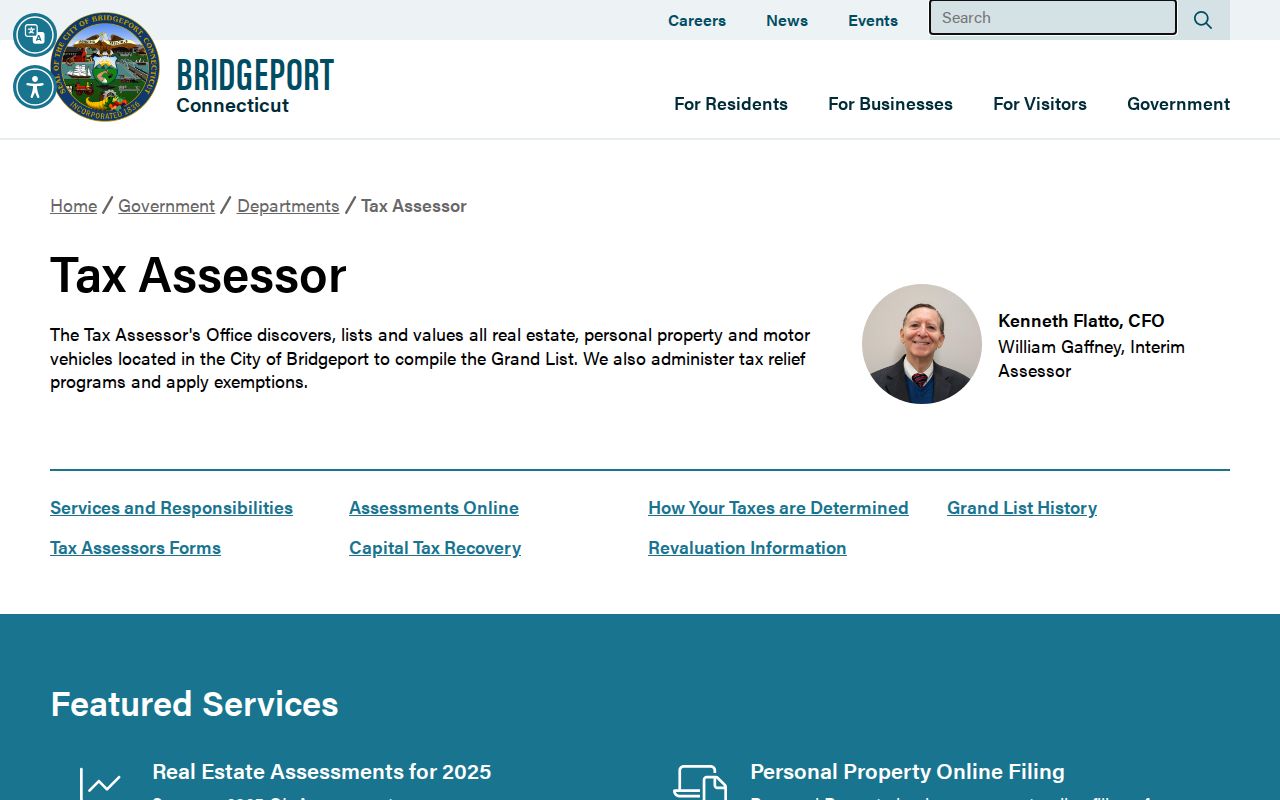
The assessor view helps turn a broad residents directory question into a parcel-specific research task. Keep the source date and do not describe the card as a list of everyone at the address.
Current Bridgeport Resident Directories
Several public systems act like partial resident directories. Each lists a different population and should be named precisely. Bridgeport has no city staff directory or public household roster in the official pages reviewed, and neighborhood plans do not publish universal member lists. The table below keeps owner, voter, recorded-party, permit, and community evidence separate.
| Source | Who or what appears | Keeper | Access |
|---|---|---|---|
| Vision Grand List | Record owners, mailing and situs fields | Bridgeport Tax Assessor | Public search |
| Individual voter lookup | Named registration, status, district, polling answer | Connecticut Secretary of the State | Individual route; protected fields withheld |
| Recorded-land index | Grantors, grantees, instruments, maps | Bridgeport Town Clerk | Free index; copies and images have fees |
| Park City Portal | Permit applicants, owners, agents, plans, inspections | Bridgeport departments | Portal from January 1, 2021; FOI for broader searches |
| NRZ plans and contacts | Organizations, boundaries, meeting routes | City Planning and neighborhood groups | Public documents; no member roll |
If the question is “who owns this parcel,” begin with Vision and the Town Clerk. If it is “is this named person registered,” use the state lookup. If it is “which group serves this area,” use an NRZ plan or community contact. The Bridgeport resident lookup workflow is useful when one name must be checked against several dated records.
Bridgeport Voter Lookup Limits
Connecticut has local registrars in all 169 towns and a centralized voter-registration system. There is no Fairfield County voter roll. Bridgeport's registrar handles local registration and updates, while the individual lookup is hosted by the Secretary of the State. The public route is designed for a named check, not a street browse or a list of every household.
The state system can return a registration answer, party or unaffiliated status, polling place, district or precinct information, and limited address data where the law permits. Public guidance distinguishes birth year from the exempt month and day. A full statewide voter file is a separate written request to SOTS LEAD with a listed $300 fee, and protected addresses are withheld. Current access questions are especially time-sensitive because the Secretary of the State published 2026 material about a dispute over voter-file fields.
The Bridgeport Registrar page is the local route for registration, address changes, and office guidance. It cannot turn an individual lookup into a public street list.
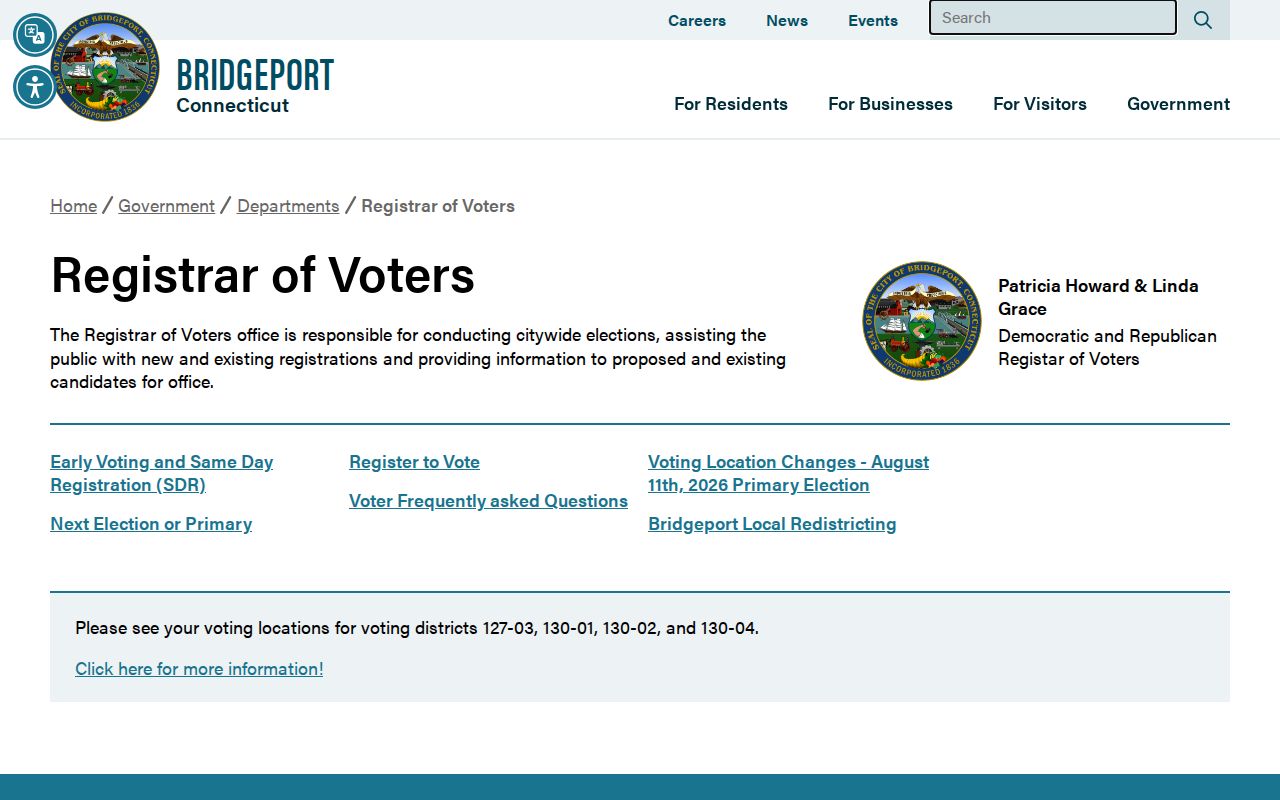
The registrar office connects local election administration to the state lookup, but a result still needs a date and a clear question. Do not treat a no-match as proof that someone never lived in Bridgeport.
Bridgeport Deeds and Resident Records
The I2 Town Clerk portal is a name and instrument index, not a simple address directory. It offers Recorded Land Name, Document, Book, and Date Search, along with a separate Maps mode. A name search can be narrowed by grantor, grantee, second party, document type, and recorded date. The selector contains 407 local document labels and abbreviations. A narrow DEED filter can miss a related release, mortgage, map, probate certificate, lien, or local label.
The verified I2 land-name index begins January 2, 1948. Land images begin June 1, 1983, while map index and images reach September 23, 1835. Search is free, watermarked viewing is available, and portal printing or downloading is paid. The Town Clerk schedule lists $70 for the first page and $5 for each additional page for standard recording, $1 per copy page, $2 for certification, and $20 for maps. Verify the current schedule before ordering.
- Grantor or grantee
- A party transferring, receiving, or appearing in a recorded instrument. The role can change across a chain.
- Index
- A finding aid with names and document details. It is not the same as the complete image or a certified copy.
- Parcel
- The legal unit tied to an assessment and land description. A street number alone may not identify it across time.
- Criss-cross directory
- A reverse directory read by address or street, useful for historical occupants rather than current proof.
When online coverage ends, ask at the Town Clerk land-record office for the book, map, or certified-copy route. Connecticut State Library and Bridgeport History Center materials can help bridge a historical gap.
Bridgeport Court and Probate Records
Connecticut's Judicial Branch serves Bridgeport through statewide systems. The civil party search accepts a required last name, optional first name, court location, case category, case type, sort order, and a name mode such as Starts With, Contains, Is Equal To, or Sounds Like. Bridgeport is a selectable location. The result can include a party name, docket, category, court location, dates, disposition information, and links to available detail, but the page says it is not the official record.
Civil information generally remains online for one to ten years after disposition, and criminal information generally remains up to ten years after sentencing, with erasure, sealing, youthful-offender, juvenile, and protected-case limits. Probate has its own lookup with district, case type, open or closed status, and party-name fields. Bridgeport Probate Court is PD48 among the state's 54 districts. Full probate documents can require registration, interested-party status, or clerk access.
The Connecticut civil party search capture shows the name and location controls used to start a Bridgeport case check.
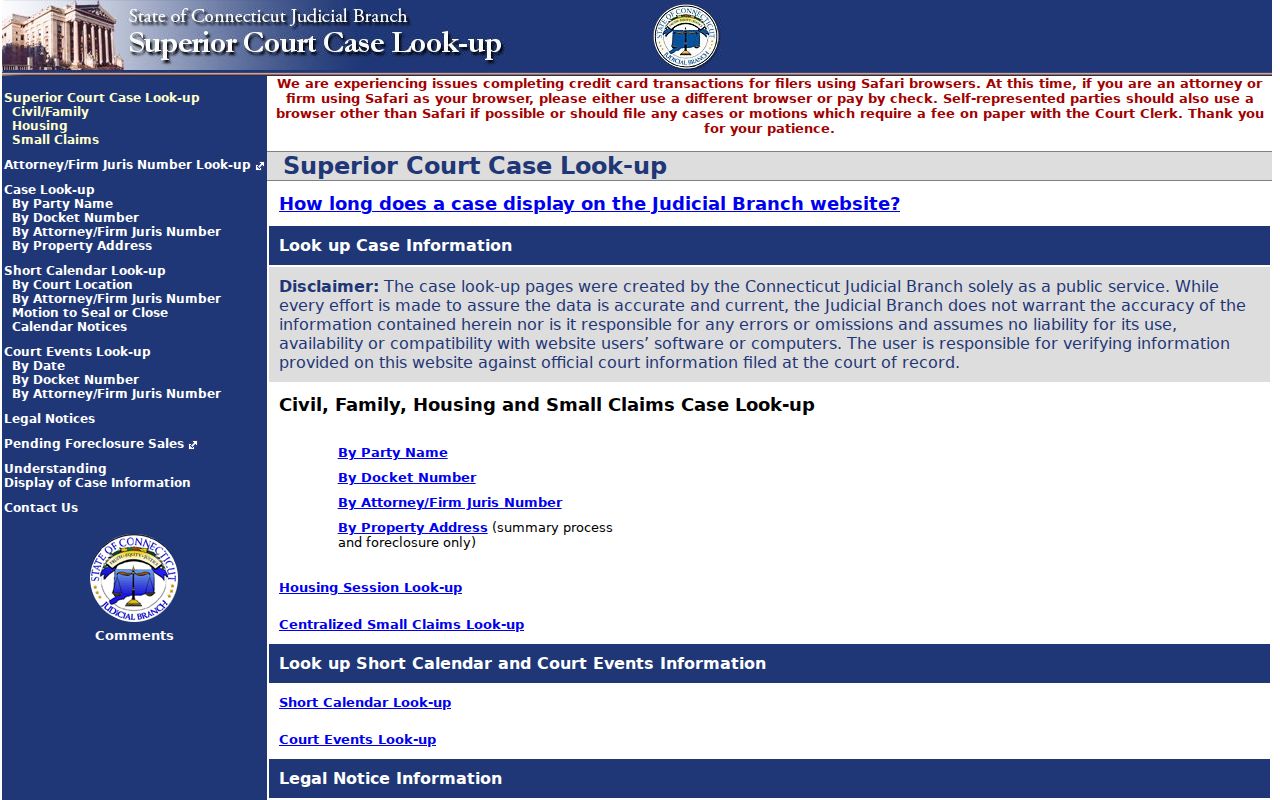
Use a court result as a time-bounded index clue. Confirm the docket and document with the Bridgeport Judicial District clerk at 1061 Main Street before relying on it.
Bridgeport Vital Records Access
Bridgeport Vital Records is the local registrar, while the Connecticut Department of Public Health administers statewide birth, death, marriage, and fetal-death records from July 1, 1897 forward. Bridgeport genealogy guidance gives local research starting points of 1850 for births, 1855 for deaths, and 1833 for marriages. A newspaper notice or directory entry can help identify an event, but it is not a certified certificate.
Birth records under 100 years are confidential under CGS §7-51 and RCSA §19a-41-2. Death and marriage certificates have broader adult access, but Social Security number fields are restricted. Bridgeport forms use identification, relationship information, and money-order instructions. The local fee table lists $20 for a full-size birth or death copy, $15 for a wallet birth copy, and $20 for a marriage copy. Genealogical searches are by appointment, require a recognized Connecticut genealogical society card and photo ID, prohibit photography, cost $20, and can take 90 days or longer.
For local hours and office routing, use the Bridgeport Vital Records page; for state forms, eligibility, and ordering routes, use Connecticut vital-record guidance before sending a request.
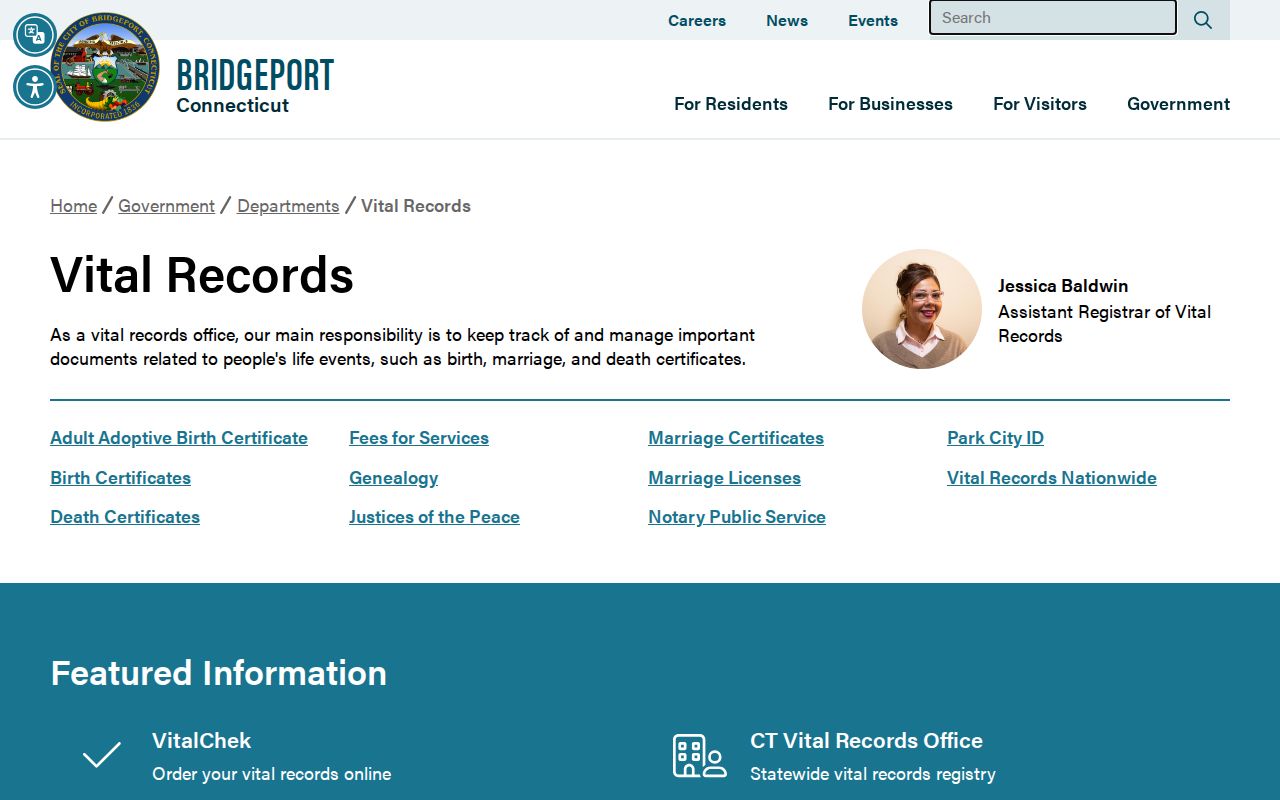
The local office is the right place to confirm a Bridgeport event, but access depends on the record type, date, relationship, and identity proof. FOI does not override those rules.
Historical Bridgeport Resident Directories
The Bridgeport History Center holds a city directory run of approximately 1855-1990. From 1895 onward, volumes generally contain both alphabetical and street sections. That pairing makes the collection more useful than a surname-only index: a researcher can read a block numerically, then compare the alphabetical entry for occupation, spouse or widow notation, telephone, and other clues. Publishers include Price & Lee Co., North American Directory Publishers, and other annual directory firms.
Older directories are historical sources, not a current resident roll. An entry may represent a boarder, spouse, caller, business occupant, or a person carried forward from a prior compilation. Use newspapers, census schedules, maps, probate, vital records, and the recorded-land chain to test a household story. The full collection, entry schema, and reading method appear on the Bridgeport city directory collections page.
The Bridgeport city directory finding aid is the place to confirm the year, format, and whether a volume is physical, microfilm, or available through a library database.
Bridgeport Business and License Records
A person can appear in a Bridgeport search through a business or professional role rather than a home address. Connecticut eLicense covers more than 850 credential types and provides free, no-login verification with holder or business name, license type, credential number, status, address, city, state, and ZIP fields. The Secretary of the State's business data tools can filter by business name, city, principal, and agent. Bulk extracts are updated nightly and capped at 1,000 rows.
Bridgeport trade names are filed through the Town Clerk, but a stable public online DBA search was not located. Search an assumed name, legal entity, principal, and credential separately. The Treasurer's CTBIGLIST is a free name search for unclaimed property, including checks, accounts, securities, and insurance proceeds. A possible name match is not ownership proof; claims require identity or heir documentation.
Use the Connecticut eLicense lookup for a credential or business affiliation, then save the credential status and date beside the result.
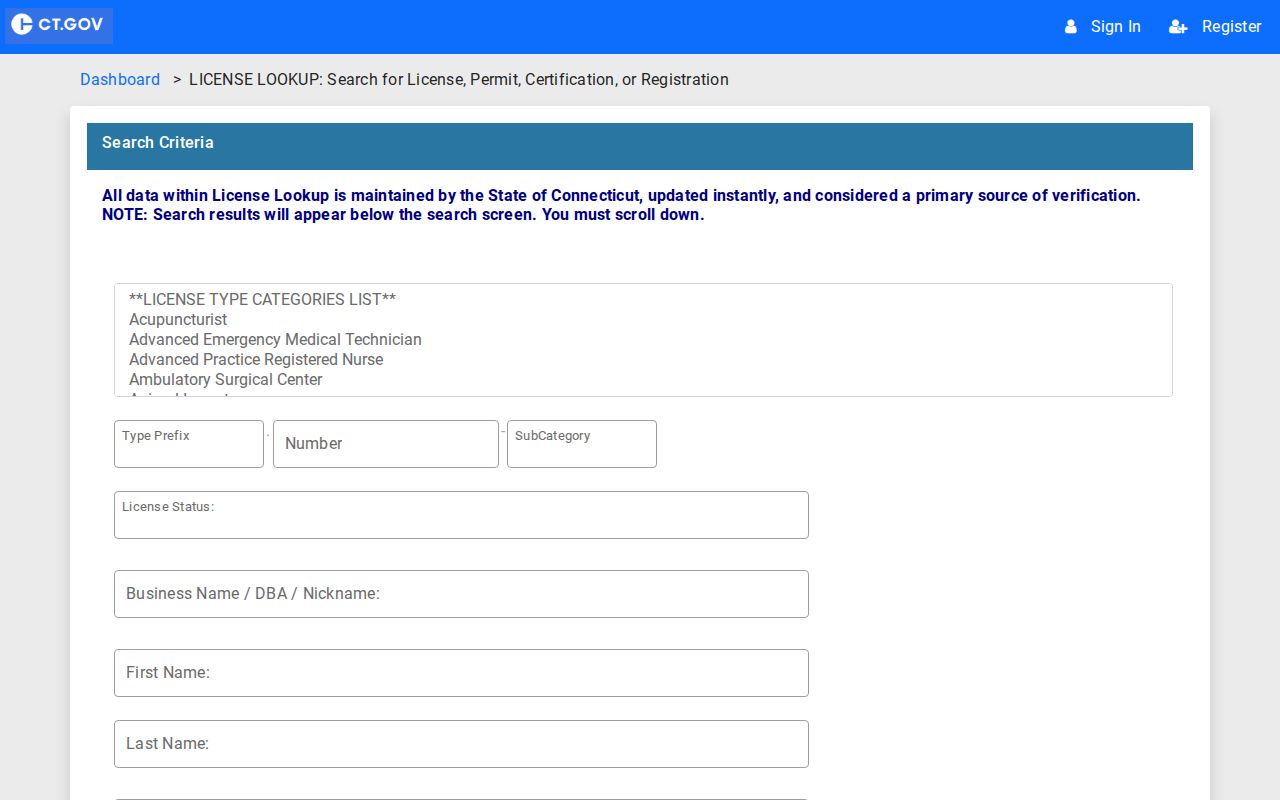
License and business records add useful context, but an entity address or license address is not automatically a person's home.
Bridgeport Lookup Privacy Limits
Connecticut's Safe at Home Address Confidentiality Program gives qualifying survivors and victims a substitute mailing address and forwarding route through the Secretary of the State. The voter Privacy Program can suppress disclosure when a person swears under penalty of perjury that release creates a safety danger. Those protections are not ordinary address changes, and they are not problems to work around by combining parcel, court, voter, or map clues.
The Connecticut Data Privacy Act, CGS chapter 743jj, gives qualifying consumers rights with exemptions for government records and other regulated data. A commercial opt-out does not erase a Town Clerk instrument, assessor card, court file, voter record, or vital certificate. For a correction, contact the custodian: the Assessor for assessment fields, the Town Clerk for land indexing, the registrar for voter records, DPH or the local registrar for vital corrections under CGS §19a-42, and the Judicial Branch clerk for a docket issue.
Lawful personal use. Public records can help with genealogy, an estate, a property question, or reconnecting with someone. Do not use a Bridgeport residents directory search to stalk, harass, intimidate, or harm a person, and do not try to reconstruct a protected address.
Bridgeport Records Requests and Lookup Gaps
Online portals are finding aids, not a promise that every record is digitized. Bridgeport's FOI request route supplements written requests by mail, email, fax, or drop-off. The Connecticut Freedom of Information Act, CGS §§1-200 through 1-243, especially §§1-210 and 1-212, covers inspection and copying of public records, but it does not open sealed court material, protected vital records, DMV data, or suppressed voter addresses.
Building property searches have a specific route: the department says searches are done Wednesdays, are not researched by phone or in person, and should go through FOI with a minimum estimate of 7-10 business days. Police report copies have separate rules, including a 50-cent-per-side fee and adjudication, juvenile, and sexual-assault limits. The History Center and Connecticut State Library are the fallback when the needed clue is an old directory, newspaper reel, map, or archive finding aid rather than a city portal.
The Connecticut FOI guidance explains the state request framework, while the city route identifies the department that actually holds a Bridgeport record.
A narrowly described request with an address, parcel ID, document number, date range, and record type is easier for a custodian to route than a broad request for everything about a person.
The Bridgeport FOI portal is another official access channel. Its dynamic form was not exposed during research, so use the city instructions and preserve the request confirmation.
The request route matters when a result is missing because the record is offline, not because the underlying event never occurred.
Date Checks for Bridgeport Records
Dates are part of the answer in a Bridgeport residents directory search. The assessor result belongs to a Grand List year. A deed has a recording date, and the I2 name and image cutoffs are different. A voter record changes through local maintenance and may be updated after an election. A civil or criminal result can disappear when its retention window ends. A directory entry belongs to a printed year that may not match a census enumeration date. That dated approach keeps the Bridgeport residents directory from sounding like a live household roll.
The 2025 revaluation and January 2026 final notice make the assessment year especially important. The 2026 SOTS releases and the State Library's compact-shelving notices show that access conditions can change while a research project is under way. Save the source URL, result date, office, record type, and any gap or restriction beside the name or address. That small habit keeps a Bridgeport resident record from being mistaken for a timeless fact.
Source note. A free index, paid image, certified Town Clerk copy, library reel, and archive consultation answer different questions. Keep the source and date with every conclusion.